Harold Frederic,
1896 Hardcover, Univ of Nebraska, 1985 December 2006
Illumination (1896) has been an underground classic among serious
writers and readers since its publication. Although it sold well in its
day, it was largely lost to mainstream attention for most of the 20th
century. Only in the 1980s did it first start appearing in school
settings with the first critical edition by Nebraska Press (and Penguin
Press editions around the same time). It has been called an "American
classic" by more than one critic and writer.
First, an explanation of the odd title. Frederic intended the title to
be simply "Illumination", which it was indeed published as in England,
but due to some mis-communication at his (soon to be bankrupt) American
publishers - a working draft had the internal working name of
"damnation" - it was mistakingly published as "The Damnation of Theron
Ware". Later publishers in the 1930s then combined the two into the full
title "The Damnation of Theron Ware, Or, Illumination".
This is an important novel and can be critically approached from a
number of perspectives. Probably most important and timeless (c.f.
Richard Dawkins "The God Delusion" (2006)) is Theron Ware's
"Illumination" about truth in religion. Is the value of religion based
on the belief in a real God, or just a belief in a god that may not even
exist - the existence of which doesn't matter - the value in religion
comes from _pretending_ to believe. It is unclear in the end if Sister
Soulsby, Forbes and others truly believe, or just pretend to believe,
and if it even matters.
The narrative technique of writing from Theron's perspective, hearing in
the first person about his own "Illumination" and personal growth (a
positive healthy thing it seems to him) - which is then re-played at the
end of the novel from other peoples perspective, is very powerful and
well crafted. It really makes the reader examine times in their own
lives when they thought they were on the right and true path. It has a
certain Rashomon theme of subjectivity and what is the truth of events
from multiple perspectives.
Enlightening The World: Encyclopedie, the book that changed the
course of history
Philipp Blom,
2004 Hardcover December 2006
Philipp Blom is a delightful writer and this is a fascinating and highly
entertaining history of the great French Encyclopedie which was a
collaborative project that took about 25 years to write in the
mid-1700s. Despite the title, this is really a book about people, with
the Encyclopedie as a thread to tie the stories together. I have very
little background in 18th C European/French history Blom makes it
entirely accessible for novice and expert alike (although I suspect many
of the stories here are well worn, but new to me, and well told).
Probably the greatest compliment is I want to learn more about those
involved, probably starting with a biography of Rousseau. This account
easily sits besides Simon Winchester's "The Meaning of Everything" and
Henry Hitchings "Defining the World". As another reviewer mentioned,
anyone with an interest in Wikipedia will find it fascinating.
Very short book on a very large and complex subject. Part of a series
called "Essential Histories" all of which follow the same layout and
format, commissioned by Osprey Publishing to academic authors. Graphics
are excellent. The content quality of this series varies widely, this
volume by Anne Curry is generally regarded as one of the better ones.
For a 4 or 5 hour overview it is very good. I wish she had provided more
historical contextual insight, as to why events were important - but she
can not be faulted for sticking to the facts.
Richard Powers, 2006 First
hardcover December 2006
Brilliant novel with a lot of thematic and subtle layers. The plot is
good, in particular how the many strands come together, but there is
more here than plot or character development. The excellent essay by
Booker Prize winner Margaret Atwood in 'The New York Review of Books'
entitled "In the Heart of the Heartland" (available online, see Google
or the Wikipedia entry for 'The Echo Maker') is the magic crystal ball
to understanding this novel (hint: it's structured on The Wizard of Oz).
Atwood calls it Powers best novel to date, and it deserves to win the
National Book Award, spill a lot of PhD ink and become a classic of
American literature, so she says.
Beyond the 'Wizard of Oz' connections, this is a novel about living in a
virtual reality (the land of Oz) - a sort of 'The Matrix'-like theme of
how do we know what is real. This may seem sci-fi, but when you consider
something like %50 of all Americans are on some sort of mood or behavior
modifying drugs, that we live in electronic bubbles of communication,
and other "virtualizations". Except unlike Oz when Dorthy wakes up and
returns home, there is no home to return too, just a facsimile of
one.
Another subtle but constant theme is the characters move in an East-West
axis while nature moves in a north-south axis (the birds, the seasons).
The intersection of these axis is the scene of Marc's accident, and the
location of where the nature-destroying building complex is to be built.
The further west one goes, the more into the land of Oz one travels,
such as at "Carhenge" where nature and man are fliped around
entirely.
I personally found this a very rewarding novel as I have traveled I-80,
been to Grand Junction and can visualize and remember the place, people
and geography. In fact, I have traveled through Grand Junction both
along a east-west axis on I-80, and a north-south axis when going from
South Dakota to Kansas right down the muddle of the plains. It really is
the center of everything, and the middle of no where (the geopgraphic
center of the lower 48 is about a quarter days drive due south of Kearny
in northern Kansas). Thanks for the trip Richard but I'm sure glad to be
home.
Voices From Chernobyl: The Oral History of a Nuclear Disaster
Svetlana Alexievich, 1997 2005 hardcover Dalkey
Archive Press December 2006
Occasionally I'll read first-hand accounts about human catastrophes in
the modern world, such as Sudan or Rwanda or Katrina, because it offers
a window into what I as a middle class American normally would never see
or experience, hopefully making me a better and wiser person without
becoming numb or a "dark tourist". Books are more subtle and rich than
film and more rewarding in the end.
As an oral history of Chernobyl this is a frightening experience (the
term "experience" emphasized). Chernobyl has been largely hushed up and
kept quiet, the scope of it is worse than most know or understand
(occasionally we hear a few hundred or thousand people died and certain
cancers are slightly up, don't believe it, much worse). Only about %5 of
the nuclear material escaped so it was a minor accident on the scale of
things. There is a %50 chance of another meltdown happening elsewhere in
the world over the next 40 years (sourced in book). Had Chernobyl been a
full meltdown much of Europe would be dieing off as we speak. 16 more
Chernobyl-type reactors are still in operation (14 in Russia). As
Alexievich says in her epitaph: "These people had already seen what for
everyone else is still unknown. I felt like I was recording the
future."
The disaster of Chernobyl is still going today, it never ended, it is
like AIDS - it just keeps getting worse, there is no cure for radiation
which lasts 100s of 1000s of years. The radiated material is finding its
way outside of the "Zone" and spreading slowly around the world. Down
the rivers into the seas, blown on dust, carried out by hand by bandits
in the form of trucks and TV's and scrap metal sold to Asian scrap metal
firms which build the goods we buy, grown in food and sold on the world
market. I put this book down thinking two things: where can I buy a
gieger counter and where can I buy iodine.
Alexievic is a fascinating person her books published around the world
in over 19 languages; translated authors don't get big billing in the
USA but she is a world-class author and pretty well known in Europe. The
Stalinst-Soviet style government of Belorussia (her home country) is not
sympathetic to independent journalists (they end up dead). She has a
fairly detailed personal website http://alexievich.info/ (click on
English).
Beryl Markham,
1942 Hardcover 1987 "Illustrated Edition" November 2006
Lifetime memoirs by British-born Kenyan author Beryl Markham (1902-86)
about her frontier life growing up in colonial Kenya. An intimate
portrait of a romantic, fragile and ephemeral time in Africa. Although
Markham was the first person to fly solo across the Atlantic from east
to west, she is best known today as the author of this book because of
its amazing writing. Hemingway (who knew Markham fairly well) said "she
can write rings around all of us who consider ourselves writers."
National Geographic Magazine rated it #8 in its "Top-100 Adventure
Books". Many of the real-life characters seen in the movie "Out of
Africa" are discussed here, including how the character played by Robert
Redford dies, and how Markham almost died with him.
A recent "tell all" book came out in 1993 "The Lives of Beryl Markham"
by Errol Trzebinski - it contends "West with the Night" was ghost
written by her third husband, who was a Hollywood ghost writer. It also
says Markham was sexually promiscuous and slept with many/most of the
males mentioned in the book. Maybe. Maybe not. It's easy to get caught
up in the drama and stories of the Kenyan colonialists. The reality is
sometimes less attractive then the romantic mythology.
Gaspar de Carvajal, edited by Jose Toribio Medina and
H.C. Heaton, 1542 and 1895 and 1934 1934 Hardcover November
2006
This book is a number of different works by different authors written
and translated at different times. At the core is a primary source 1542
"Account" by Friar Gaspar de Carvajal about the first voyage down the
Amazon River by Captain Francisco de Orellana in 1542, of which Gaspar
de Carvajal was a member of the voyage. Gaspar's "Account" remained
unpublished and obscure until 1895 when Chilean historian Jose Toribio
Medina published a modern Spanish translation, along with a book-length
Introduction and dozens of other primary source documents about the
voyage. This combined work was then translated into English in 1934,
along with some additional material, which is the book being reviewed
here under the full title: "The Discovery of the Amazon: According to
the Account of Friar Gaspar de Carvajal and other documents. As
published by Jose Toribio Medina. Translated from the Spanish by Bertram
T. Lee. Edited by H.C. Heaton."
My copy is the 1934 hardcover by the American Geographic Society
("Special Publication No. 17") and is a large weighty old musty tomb
that looks like it belongs on the shelf of a governmental library. The
"Account" by Gaspar is amazing, this is the first primary source
document of 16th C Spanish exploration I have read. It is no literary
masterpiece but that adds to its authenticity. There is a considerable
amount of adventure, privation, death and exotic encounters.
The "Account" was the basis for the 1973 German classic film "Aguirre,
the Wrath of God" and it also contains the first mention of "Amazonian
warriors", an all-female martial society (whose existence remains a
mystery). It is also a fascinating look at how populated the "New World"
was before European diseases wiped out %95 of the population in the 16th
and 17th century - Gaspar recounts stretches of the river lasting for
100s of miles which were densely populated as far inland as could be
seen. Even to this day such population levels do not exist and recent
archaeological evidence seems to support this (see "1491" by Chalres C.
Mann).
Albert Camus, 1942 Hardcover,
Everyman's Library November 2006
Camus' third book and probably most famous - sadly on every high school
reading list - is an ambiguous, paradoxical and open to endless
interpretation novel - a perfect garden for literary trainees to play in
a sandbox with no sharp corners and lots of possibility. Camus, a native
Algerian, was just finishing his Philosophy degree in Nazi occupied
Paris when it was published, an historical axis in place and time.
Beneath the possibly derivative plot (see "Native Son" below) is an
existentialist view on life, called "Absurdism", which had roots in the
Enlightenment 16th century - truth is relative, believe what you can
experience, God doesn't exist, life has no meaning. The kind of happy
stuff we label "modern literature".
The novel reminded me a lot of Richard Wright's "Native Son" (1940),
unsurprisingly both Wright and Camus were minority authors -- replace
the story of Bigger and racism, with Meursalt and Absurdism. Both are
young men who operate outside the normal social conventions (or so it
appears), both run into trouble with the law, both are put on trial and
condemned to die for murder, both have a cell-room confrontation with a
priest, both a final epitaph. The 1940's were an "absurdest" time in the
world. "Strangely", George W. Bush, the U.S. President known for his
anti-intellectualism, was seen reading this book in 2006.
Rome's Gothic Wars: From the Third Century to Alaric
Michael Kulikowski,2006 Hardcover, first (dated
"2007") November 2006
This is a short book and easy to read but is packed with eye openers, it
is valuable both for a hobbiest like myself and the professional. I
recently read Peter Heather's "The Fall of the Roman Empire" (2005), as
well as other survey accounts of the Goths including Gibbon and Bury
(and of course the History Channel "Barbarians") - Kulikowski's writing
style is great, it's difficult to tire of such an incredible story,
everyone tells it a little differently adding new ideas and
perspectives.
More than a survey, Kulikowski makes a bold (and convincing) case about
the origins of the Goths and what motivated them (or not) to cross the
Danube in 376. In addition we learn about the latest approach to
barbarian ethnicity (called "ethnogenesis") which is applicable to all
the ancient peoples and important to understand in the face of so much
racist and nationalistic scholarship out there; an excellent
historiography of Gothic studies which reveals some interesting
connections to modern educational institutions; a general overview of
the barbarians and the Roman Empire; a "Further Reading" where we get
the authors recommendations on the best books available for specific
topics; a list of key names with short descriptions (about 150
names).
This is the first in a series which is described in the opening matter:
"This series is composed of introductory-level texts that provide an
essential foundation for the study of important wars and conflicts of
classical antiquity. Each volume provides a synopsis of the main events
and key characters, the consequences of the conflict, and its reception
over time. An important feature is the critical overview of the textual
and archaeological sources for the conflict, which is designed to teach
both historiography and the methods that historians use to reconstruct
events of the past."
1491: New Revelations of the Americas before
Columbus
Charles C. Mann, 2005 Hardcover,
first November 2006
The past 40+ years have seen scientific revolutions in many fields
including demography, climatology, epidemiology, economics, botany,
genetics, image analysis, palynology, molecular biology, soil science,
and others. As new evidence has accumulated, long-standing views about
the pre-Columbian world have come under increasing pressure. Although
there is no consensus, and Mann acknowledges controversies, the general
trend among scientists is that 1a) the population levels were probably
higher than traditionally believed among scientists (known as "high
counters"), 1b) humans probably arrived in the Americas earlier than
thought over the course of multiple waves (not a single land bridge
crossing window) 2) The level of cultural advancement and settlement
range was higher and broader than previously imagined and 3) the New
World was largely not a wilderness but an environment controlled by
humans (mostly with fire). These three main focuses (origins/population,
culture, environment) form the basis for three parts of the
book.
This is a good survey of the state of things circa 2005. Given the pace
of change it will need to be re-written in a decade or so. I'd been
hearing snippets of these theories over the past 20 years and was never
attached to the "old views" (who is?), so over-turning them is not a
great upset and often a revelation. The details of specific cultures and
places were mostly new to me and highly educational. The biography is
excellent if not extensive (everything from 16th unpublished documents
to Fodors Travel Guide to Mexico), but about a dozen of the most
important works are discussed in the first Notes page.
Something New Under the Sun: An Environmental History of the
Twentieth-century World
John
Robert McNeill, 2000 Hardcover, first November 2006
Sub-titled "An Environmental History of the 20th Century", this is a
sober and objective survey of environmental changes over the past 100
years. I was concerned this would be an emotional appeal or judgmental
polemic from the left - but not the case, it is academic and
professional history from an environmental perspective (the environment,
not the "environmental movement"). It's encyclopedic in scope and
style..
I would not call this an "entertaining" read (although some of the facts
really fire the synapses), but it is deeply rewarding as a broad survey
of a very large and complex problem. The chapters and sub-sections are
arranged in a logical outline making it possible to read the chapters in
any order..
The main idea of the title "something new under the sun" is that humans
have so fundamentally changed the environment that things really are
very different now than they have ever been historically. To regard our
current conditions of energy availability, access to water, unending
economic growth - as enduring and normal appears to be an interesting
gamble given the facts..
Some interesting trivia: humans did not become the dominate primate
until about 8,000 BC with the rise of agriculture (baboons outnumbered
humans before then). About one-fifth of all humans that ever lived did
so in the 20th century. In sheer energy terms, if all modern technology
and energy sources were not available, the average American would need
about 70 human slaves to maintain the current standard of living (each
American "directs" 70 energy-slave equivalents). Each year, humans move
more earth and soil than glaciers, wind erosion, mountain building
(plate tectonic uplift), and volcanoes combined. Probably the single
most damaging biological organism in earths history was the human
primate Thomas Midgley Jr from Beaver Falls, Pennsylvania born in 1889.
He invented Freon (which destroys the Ozone layer), and also leaded
gasoline, which has polluted most of the worlds soil lasting thousands
of years (all of us carry elevated lead levels because of it and will
continue to do so for centuries to come, leading to birth defects,
lowered IQs, etc..). Midgley contracted Polio at age 51 and invented a
system or ropes and pulleys to move his crippled body off the bed - he
became tangled and was strangled to death in 1944 by his own invention,
before learning how damaging his inventions were.
Chinua Achebe, 1958 Hardcover, Everyman's Library 2001 November
2001
'Things Fall Apart' has been described as Africa's "best-loved novel",
read widely not only in Nigeria, where it was written in 1958, but
across the entire African continent; it is studied and taught in Europe
and North America where 100s of papers and dozens of major studies have
been written; it is said that in Australia or India it is the only
African novel that most people know about. It has been called the
"archetypal modern African novel written in English". [See Kwame Anthony
Appiah's excellent "Introduction" in the Everyman's Library
edition.]
The novel is about an African tribe along the Niger River that
experiences British colonialism around the turn of the 20th century. The
first 2/3's of this short novel establish the customs and day to day
life focused on one man and his family named Okonkwo. Into this arrive
"white men" (British) who begin to change things, until eventually
"things fall apart" leading to Okonkwo's death. The novel is not a
"black and white" story of heroes and villains, of romantic old-world
customs destroyed by modernity - rather the old customs have good and
bad points, the British have good and bad points - even the hero of the
novel, Okonkwo, is fairly unlikeable in many respects. The subtle
balance between the good and negative gives the novel a great deal of
believability, re-readability and instruction.
Although we learn a lot about the specifics of the Ibo-speaking people
along the Niger (historically accurate as Achebbe was born into that
culture) the novel transcends the tribe, even Africa. It provides a
realistic window into what it is like for tribal people who are being
globalized - from Native Americans in the age of Columbus, to
present-day Amazonians. This first-hand subjective experience of the
novel transcends the many lengthy tombs of history and anthropological
studies of colonization.
Knights of Spain, Warriors of the Sun: Hernando de Soto and the
South's Ancient Chiefdoms
Charles
Hudson, 1997 First, hardcover, signed by author November
2006
I probably first read or heard about de Soto in high school, but until
recently he was just a name, one of dozens of Spanish Conquistadors.
Then in 2002 while traveling through the Tampa, FL area I came across a
National Park commemoration where he first landed on a 4,000 mile 3-year
trek through North America. Being there in person my imagination was
fired and I've been fascinated by de Soto's journey ever since. I can
still smell the salt air, hear the surf and see the Spanish horsemen
moving through the shadows of the red mangrove forest. In terms of
discovery and epic adventure de Soto is easily equal to Lewis and Clark
- perhaps more so.
This is the single best book available about de Soto, representing 20
years of research and incorporating the latest in archaeological
evidence. The route is historically a subject of great controversy as
each state has commemorative trails and sites that occasionally change
with new scholarship, and thus upset town leaders and merchants who
depend on tourism.
The books is a masterpiece incorporating details from many layers to
create a highly textured and easily imagined vision of the Spainards and
Indians. Hudson is an anthropologist and takes a multi-disiplinary
approach which creates a much richer work than a straight historical
narrative. One could spend a lot of time immersing in the details of the
route and it is most interesting since it took place on American soil,
and one can easily physcially re-trace and visit the locations today -
even my fathers back yard in Columbia SC may be along the route!
Also recommend these reviews of the book which are very good: here
and here.
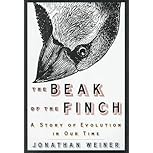
The Beak of the Finch: A Story of Evolution in Our
Time
Jonathan
Weiner,1994 Hardcover,
first September 2006
I asked someone what one book by (or about) Darwin would they recommend,
and this is it. It explains Darwin's ideas very clearly through the
example of the finche's, plus the most recent findings and discoveries
about evolution, things even Darwin did not imagine how powerful and
widespread evolution is. This book is so well written - on the level of
literary masterpiece - it is on many school circulars. It will change
the way you see nature as "infinitely more fluid, shifting, alive. It
will seem like a different planet.." Indeed.
Pope Pius II,
1464 Hardcover, The I Tatti Renaissance Library,
2003 October 2006
The is the only autobiography ever written by a reigning Pope
(r.1458-1464), it is very entertaining and well written. It offers a
window on a Renaissance man and his life and world written in his own
words. This recent 2003 Harvard University translation is modern and
easy to read, with the original Latin text on each facing page. It is
mostly about current political events of the day ( a time of great
conflict and strife) and memorable scenes from his life, written with
great artistic skill by a master of rhetoric.
Some of the more memorable scenes including his trip to Scotland where
he stays the night in a hay-loft with two Scottish women.. the
incredible set-piece when he is elected Pope, the drama of which is
nothing short of some of the best I've read in a while, his entire life
leading up to this scene : "All sat in their seats, pale and silent,
thunderstruck, as if in a trance. For some time no one spoke, no one
opened his lips, no one moved any part of his body except his eyes,
which kept darting about." And the travel from Rome northward to meet
with the Holy Roman Emperor to discuss what to do about the Turks and
the recent Fall of Constantinople - in particular some of the accounts
of lords and the tortures and sexual abuses they committed were really
very shocking - a window on the world as it was.
Admiral of the Ocean Aea: A Life of Christopher
Columbus
Samuel Eliot Morison, 1942 Hardcover,
first October 2006
"Admiral of the Ocean Sea", Samuel Morison's 1942 Pulitzer Prize winning
biography of Christopher Columbus, is still considered by many to be the
best there is.
Morison spent 2 years on a sailboat re-tracing Columbus' voyages
bringing a first hand immediacy and perspective that gives it unusual
authority on all technical aspects of sailing and navigation. In
addition Morison was a Harvard history professor whose research of the
written record is impeccable. Even before Columbus died in the early
16th century, there have been countless controversies and debates about
many aspects of his life and voyages. Into this maelstrom of legend,
myth and folklore - like the discover he writes about - Morison brings
order, calm and reliable passage through one of the most fascinating and
mythological figures of World History.
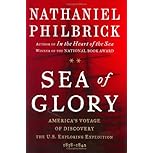
Sea of Glory: America's Voyage of Discovery the U.S.
Exploring Expedition 1838-1842
Nathaniel Philbrick,
2003 First, hardcover October 2006
This 1830's American naval exploration of the Pacific and Antarctica
could have been as famous as the Lewis and Clark Expedition, but it is
largely unknown today because it was surrounded in controversy by its
unlikeable captain Wilkes (a real-life model for evil captains like Moby
Dicks Ahab and Queeg in The Caine Mutiny). Philbrick tells the story of
the expedition through the colored lens of the captains unlikeable
character and thus while I found it interesting, it was never heroic and
often pathetic to spend time with him and the often equally unlikeable
crew. Yet at the same time he and the expedition accomplished a lot and
delivered the goods - the contradictions are enough to make your stomach
turn.
My personal impression is that the American generation of Wilkes and his
crew were not heroic - the sons and grandsons of the great Revolutionary
War generation, they were driven by idealism and optimism to change the
world, but they were also self-centered and self-serving, not unlike the
contradictions of the "me" generation Baby Boomers post WWII. The
in-fighting and insecurities of everyone involved, on the expedition and
back in Washington, reflected a mood of a young, insecure nation. Had
this expedition gone differently it might have inspired a romantic
interest in expanding America not only across the West but far beyond
into the Pacific and the western coast of Canada. Instead the ExEx "slid
into obscurity."
H.G. Wells, 1897 The Heritage
Press, 1967, hardcover w/ slipcase + Audibook version October 2006
H.G. Wells was a prolific Victorian English author who is best
remembered today by four novels written in a three year period early in
his career: "The Time Machine" (1895), "The Island of Dr. Moreau"
(1896), "The Invisible Man" (1897) and "War of the Worlds" (1898). He
was writing "The Invisible Man" at the same time he was working on "War
of the Worlds" which came out just a few months later. According to one
commentator, a common characteristic of all four novels, and the secret
of their success, is their graphic violence contrasted with the
innocence of their settings.
Wells was not the first to write of invisibility, other works from the
19th century include Gui de Maupassant's "Le Horla" and American
novelist Fitz-James O'Brien "What Was It?". However it was Well's who
created the mythological character that is immediately recognizable to
anyone who has never even read the book. The invisible man, Griffith, is
partly a mad scientist in the tradition of Dr. Frankenstein and Dr.
Jekyll dabbling in the mysterious arts, and partly a warning about the
dangers and fears of science to an innocent public which was seeing
dramatic change brought on by scientific advances.
The first part of the novel is fairly light-hearted with the invisible
man seemingly a sad victim of his fate trying to hide his true nature
and scorned by society, and even dogs. But then he begins to commit
petty crimes, even gleefully taunting those around him - and then he
designs to go on a "reign of terror" - similar to Frankenstein who was
born innocent, but taught by those around him who saw only the fearsome
and loathsome, he lives up to his reputation and becomes the evil which
others "see" (or don't). His creation of invisibility is an innocent
act, but it is man reaction and use of that invention that leads to
evil.
"The Invisible Man" can also be contrasted with the English 'Invasion
Literature' genre that was popular at the time ("War of the Worlds" is
invasion literature canon). Similar to "Dracula" (1897) which played on
the fears of a foreign invasion of the "dark" Eastern Europeans, "The
Invisible Man" was a "Stranger" (the title of the first chapter),
invading the otherwise peaceful confines of a quiet and normal English
village.
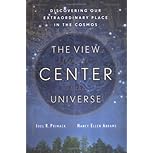
The View from the Center of the Universe: Discovering
our Extraordinary Place in the Cosmos
Joel Primack and Nacy Abrams, 2006 Hardcover, first October
2006
This is a visionary book that sets out to change the world by changing
how we see our place in the universe, by changing peoples attitudes
about the metaphors and stories we use to describe the universe and mans
place in it. Instead of seeing ourselves in entrenched Newtonian
existential terms (a small rock circling a small star in an average
galaxy in a nearly infinite scale universe where nothing that humans do
matters in the big picture like a lone plankton floating in the ocean),
the authors re-position earth and humans to a central importance,
supported by the latest science findings. Incredibly, they make a
convincing case, and along the way educate the reader about the latest
scientific findings in cosmology.
The idea of mans centrality to the universe has been the norm for most
of history - the medieval model, Egyptian cosmology, etc.. all saw man
and earth at the center of the universe - the first third of the book
discusses this. It was with Newtonian physics that our place in the
center was over-turned. But incredibly in the past 10-15 years its
become apparent we really are at the center - depending on your
perspective, as discussed in the middle portion of the book - 1)We are
made of the rarest material in the universe (visible matter) 2) We live
in the center of a "Cosmic Sphere of Time" (every point in the universe
is physically in the middle because there is no middle of the universe)
3) We live in a mid-point of time - most nearby galaxy's are middle age
4) We live in the middle of all possible sizes - there are 14 orders of
magnitude difference between the smallest and largest, we are in the
middle 5) We live at the mid-point in the age of our planet. 6) We live
at a turning point for our species when population and environmental
questions are raising serious questions about sustainability.
The last third of the book becomes more subjective about going forward
into the future how we can change our attitude about the universe to be
more optimistic and meaningful: "The choice of attitude is not a casual
one.. cosmology is not a game it has the power to overturn fundamental
institutions of society.. Once we made this mental shift and opened our
eyes to the view from the center of the universe.. it evoked the
opposite emotions from the existential stance-not despair but hope, not
resignation but excitement. These may be arbitrary emotions, but they
lead to non-arbitrary actions."
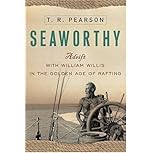
Seaworthy: Adrift with William Willis in the Golden Age
of Rafting
T.R. Pearson, 2006 First,
hardcover October 2006
It's hard to image now, but when Thor Heyerdahl's set out "Kon-Tiki" in
1948, most people said he was crazy and was sure to die - so when he
lived to tell about it, becoming a world-wide celebrity, it set off a
raft of imitators in the 1950s and 60s, which Pearson calls the "Golden
Age" of rafting.
The subject of the book, William Willis (b. 1897) was a working-class
German immigrant blessed with physical stamina and mechanical know-how
from a lifetime of working odd-jobs at sea and land, he was a man of
extreme habits and strong personality - for example he lived on a
bizarre diet (for the 1950s) of home-grown organic raw vegetables and
grains. A greybeard in his 60s, he decided to test himself and follow
Heyerdahl's example in a balsa raft, setting adrift from Peru westward,
he went entirely alone. His successful expedition, global press
attention and books which followed made him a household name for a brief
time, but today he is largely forgotten and unknown.
The book discusses not only Willis' five separate raft trips over a 15
year period or so - Willis was well into his 70s by the end - it is a
survey of other rafting expeditions from the "Golden Era" including
Kon-Tiki, Tahiti Nui (I,II and III), Lehi (I,II,III,IV), and Alain
Bombard. Each is a fascinating mini-account told by an accomplished
novelist.
Pearson's portrayal of Willis is often unsympathetic - perhaps rightly
so and for the same reasons critics in the 1950s and 60s were. Unlike
Heyerdahl who set out for a scientific reason and greater purpose,
Willis did it for no reason other than to see if he could personally do
it. Willis often made major mistakes such as taking contaminated water,
not taking a spare set of sails, not correcting a dangerous medical
condition - Willis knew better and understood his risk but seemed to
undermine himself for the thrill of the adventure.
Carol Kyros Walker,
1992 First, hardcover September 2006
Three books in one. Book one is a roughly 50-page literary history of
John Keats surrounding his 40 day tour to Scotland, where he contracted
TB and died of it a few years later at a young age. Book two is a
roughly 100-page photo art book in which Carol Walker re-traces his
footsteps taking beautiful shots along the way with relevant quotes
beneath the pictures. Book 3 are Keat's actual travel notes - they are
letter form and were never intended for publication but are presented in
heavily footnoted format.
This is the third Carol Walker book I've read and they are all of
similar quality and scope. I think this is the 2nd best (Dorothy
Wordsworth being the best) - very enjoyable series (and very
affordable).
Tobias Smollett,
1766 1979 Folio Society hardcover + 1999 Oxford World's Classics
pb. September 2006
Cantankerous, spleen-filled, sickly 42-year old Scottish novelist
travels with his Jamaican wife through France and Italy on the Grand
Tour circuit. Complains and gripes about everything for two years
straight. Fascinating portrait of the man, the time and place. Despite
the pessimistic and negative tone (traits one normally wants to avoid in
a travel companion) it is perversely entertaining.
Lew Wallace, 1880 1908
hardcover Sears Roebuck "Wallace Memorial Edition" (1M copies),
560-pages September 2006
Most people probably don't know the 1959 Hollywood classic film starring
Charlton Heston was based on a 19th novel by a retired American Civil
War general. It was one of the best selling novels in American history,
but by 1959 had been largely forgotten. While the novel is never listed
as "great literature", it does have a compelling plot and story. Even if
you have seen the movie(s) it is worth reading as there are substantive
differences and sub-plots that never made it to the screen. I also found
sections, even entire chapters, that could be quickly skimmed over as
they were Wallace's polemics that have nothing to do with the novel or
plot. Like in the movie, the chariot race is a highlight. The movie is
consistently ranked as one of the best and most important films in
American history, a recent 4-DVD edition came out in 2005 - if your
serious about the movie, you can't go wrong with reading the
novel.
My copy is the Sears Roebuck "Wallace Memorial Edition", printed in 1908
it was, and remains, the single largest print run of any book in
American history at 1 million "limited edition" - there are so many that
in the 21st century it can still be purchased on the used market for
less than $3 a copy ($5 with shipping). I'm not sure why anyone would
buy a new paperback when classic quality hardcovers are available for so
cheap.
I have updated the Wikipedia
article with additional background and historical context about the
novel.
Alexandre Dumas, 1844 Hardcover trans. Richard Pevear 2006,
670-pages September 2006
An "endless adventure" breathlessly moving from one scene to the next:
sword-fighting, court espionage, sex scandals, poisonings,
assassinations, undying love and so on.
Les Trois Mousquetaires was translated into three English
versions by 1846. One of these, by William Barrow, is still in print and
fairly faithful to the original, available in the Oxford World's
Classics 1999 edition. However all of the explicit and many of the
implicit references to sexuality had been removed to conform to 19th
century English standards, thus making the scenes between d'Aragnan and
Milady, for example, confusing and strange. The most recent and new
standard English translation is by award-winning translator Richard
Pevear (2006). Pevear says in his translation notes that most of the
modern translations available today are "textbook examples of bad
translation practices" which "give their readers an extremely distorted
notion of Dumas's writing."
The Omnivore's Dilemma: A Natural History of Four Meals
Michael Pollan, 2006 First hardcover,
413-pages September 2006
This is a fantastic book. Most of it I already knew fundamentally and
was not new, yet his writing style, his ability to use images to capture
the essence of an idea, to communicate ideas, is really brilliant. It's
also really funny in parts. Some of it is based on his now-famous NYT
article "Power Steer", but here we get even more detail. The story of
corn is covered in more detail in Richard Manning's Against the
Grain (see previous entry below). He talks about Polyface Farm,
which is where I already get my food from, so that was really cool to
learn in detail about the chickens and beef I eat, and the Salatin
family (they are like rock stars now - how weird, they are just farmers)
- it makes me want to be a farmer.
_________________________________________________________________________
Breaking Away: Coleridge in
Scotland
Carol Kyros Walker, 2002 Hardcover,
192-pages August 2006
This is a sequel to Walker's "Recollections of a Tour Made in Scotland"
(below). It covers what happened to Coleridge after he separated from
the Wordsworth's on the third week. You would need to read
"Recollections" before reading this they are go hand in hand.
Everything about these books is a true pleasure and obvious labor of
love. Not only is Carol Walker a skilled photographer, literary
historian and writer, but a hiker and thorough researcher. These books
are of real and lasting scholarly merit, but they are also truly
enjoyable, and also make excellent coffee table pieces! What more could
you want, every book should be like this, it's one of my favorites,
comparable to the Norton Annotated series (Huck Finn, Xmas Carol,
etc..).
Most of the book is photos but the first 25 pages is a great literary
history of Coleridge and Worsdworth, and their relationship and falling
out, and how that played into their trip to Scotland. It is entirely
human and understandable and gets to the core of the matter of what is
friendship.
Herman Melville, 1846 Hardcover 1930,
360-pages August 2006
Herman Mellville's first book. A "true account" of 4 months held captive
by a Polynesian tribe known as the Typee on a South Pacific island. It
was his most popular and well known book throughout the 19th century and
his lifetime - critics would judge his future works as "downhill". It is
now seen as just the beginning of a career that climaxed with Moby. The
book is a genre-original, it created the South Pacific Romance, nothing
like it had ever been seen before and would influence many. It was
pronounced in the 1930's as probably being fiction so it did not have
the impact it would have otherwise but still some of if must have been
true? I want to believe.
I found the grammer stilted and the vocabularly cumbersome yet it still
flowed poetically one can predict what will be said in spirit just
before it is said, a strange yet magical connection between author and
reader across 170-years that trancends words. It is easy to see why this
was so popular - sunshine, tropical beaches, naked natives, no work all
play - the spirit of the California beach bum surfer can be found in
Melville.
A Sense of the World: How a Blind Man Became
History's Greatest Traveler
Jason Roberts,
2006 Hardback first, 358-pages August 2006
A "creative non-fiction" popular biography of James Holam (1786-1837),
an English navel officer during the Napoleonic Wars who lost his
eyesight and went on to travel (solo) around much of the world at a time
when global traveling was a new endevour. He wrote a number of
best-selling books and was famous in his time but has since been lost to
obscurity -- his life story has been resurected from scant sources by
Roberts into a highly sympathetic and loving biography.
This can be a life changing book, it shows how to turn what was
considered a disability so severe that he could only be a street begger
into a strength and asset that brought him more fame and experience than
he probably would have had otherwise, all the while achieving his life
ambitions. It also shows what it is like to be blind and how aware of
the world blind people are and can be through echo-location
clicking.
Couple quibbles. The author Jason Roberts had very few sources to draw
on so there are large gaps in the level of detail of Holman's life
narrative. It's hard to tell what is authentic Holman and what is
Roberts interpretation of Holman, in particular when it comes to
Holman's motivations and thoughts. A very enthusiastic and sympathetic
biography, there is little critical discussion, in fact Roberts seem to
take offense to contemporary critics of Holman without examining it
through appropriate historical context (such as Locke's then-popular
notions that knowledge is gained through sensory input, etc..). Given
the lack of primary sources and corresponding lite number of notes and
references it is more akin to a feel-good human-interest magazine
feature story. The audience is a popular one, Roberts largely avoids
using numbers, such as dates (which I found cumbersome to keep track of
chronology), and no numbers marking footnotes. No discussion of the
English Grand Tour tradition, which is what Holman did on his first trip
to Europe - we are led to believe it was just a random trip - even
climbing Mt Vesuvius was a standard Grand Tour destination, Holman
basically did what everyone else was doing, which by the 1820s was
considered blase. No discussion of colonialism and the role travelers
played in creating colonial tropes that are still popular to this day;
or the sense of national duty English gentleman travelers/explorers had
as a part of English colonialism. There is a lot of scholarly material
on English travel literature of this period that would have been useful
to put Holman into historical context. This is not a definitive
biography, or even a critical one, it is a well told story for a popular
audience that will hopefully draw more literary critical attention to
this fascinating person.
Recollections of a Tour Made in Scotland, A. D. 1803
Dorothy Wordsworth, 1874 1997 hardcover by Carol Kyros Walker,
218-pages August 2006
"Recollections of a Tour Made in Scotland, A. D. 1803" (1874) is travel
literature by Dorothy Wordsworth about a six-week, 663-mile journey
through the Scottish Highlands starting on August 15th 1803 with her
brother William Wordsworth and mutual friend Samuel Taylor Coleridge,
all important authors in the burgeoning Romanticism movement. The trip
itinerary was in part a literary pilgrimage to the places associated
with Romantic Scottish figures Robert Burns, Ossian, William Wallace and
contemporary Sir Walter Scott. She wrote Recollections for family and
friends and never saw it published in her lifetime. Some have called it
"undoubtedly her masterpiece", and one of the best Scottish travel
literature accounts during a period in the late 18th and early 19th
centuries which saw 100s of such examples. It is often compared as a
Romantic counterpart to the Enlightenment-era "A Journey to the Western
Islands of Scotland" (1775) by Samuel Johnson written about 27 years
earlier.
The edition I read is by Carol Kyros Walker (1997) of Yale University
Press who re-traced Dorothy's path through Scotland taking 100's of
beautiful B&W pictures along the way, including a detailed map - reading
this edition was very much a multi-media experience with the base text
by Dorothy, the map, the pictures and the footnotes - it's hard to
imagine a better way to read an old travel book. One of the interesting
themes of the book is the "picturesque" which was an aesthetic style in
vogue at the time, a way of looking at the landscape first described by
William Gilpin. The concept of picturesque is often difficult to
understand and describe, I recommend reading the Wikipedia
article on
the topic before reading this book, to see and understand how and
why
she describes things the way she does - in the end the reader will have
a primary source appreciation of what picturesque means. Indeed it was
the picturesque that inspired touristic tendencies in Scotland during
that period.
Update August 2006. I wrote a Wikipedia
entry for the book which recieved a "Good Article" nomination and
was featured on the English Wikipedia front page "What's New"
section.
Karl Philipp
Moritz, 1783 1965 translation by Reginald Nettel,
191-pages August 2006
The author is a very likeable young German who is in love with all
things English and travels to England for the first time on a solo
8-week walkabout. His optimism and enthusiasm is infectious. We get to
see England in the time of Samuel Johnson as he travels around looking
at the sites. The mannerism and mood of the people comes across --
history books don't convey such direct experience, much less in such an
entertaining manner. Sadly this translation is the only reliable one and
it was last printed in 1965, but copies are available on the used
market. Well worth the journey!
Travel Writing 1700-1830: An Anthology (Oxford
World's Classics)
Elizabeth Bohls and Ian Duncan (editors),
2006 First paperback, 496-pages August 2006
This is an anthology composed of 77 excerpts from travel writings by
English authors in the 18th century. It is organized into sections or
categories geographically (South Pacific, Europe, etc..). Each
excerpt/author is preceded with a pithy historical background, as is
each section, and there is a general Preface. The selections are rounded
from the well known Captain Cook to little known private letters of
women travelers to slave narratives to exploration accounts.
Overall this is like having a well-read instructor introduce you to the
best and most well known travel writing, and most interesting sections
from each text. Many of these accounts I have heard of before but never
would have the time to read in full, but in excerpt form I discovered
about 20 that were so good I would like to continue on and read the
books in full. The editors notes are very learned (if not too pithy) and
give excellent context and background to each text and category - it is
certainly possible to study history through travel narratives, and have
a great time doing it!
Katharine Scherman,
1956 First hardcover, 323-pages July 2006
The year is 1954. Katharine Scherman, her husband and a number of other
scientists / amateur scientists from the US Northeast paid their own way
for a six-week trip to the remote island of Baylot in the Canadian
arctic where they live with an Inuit community. Unlike much literature
of the Arctic, this is not a story of exploration, physical hardship or
overcoming impossible odds - it is a happy and relaxed trip where
nothing particularly noteworthy happens - they tramp around with
Eskimo's in a care-free existence, take trips around the island via dog
sled, observe birds and wild-life, listen to Inuit stories and myths,
become like family with the natives. Katharine's writing is very vivid
and easy to visualize, one becomes "lost in the book", living the day to
day life with the Inuit, experiencing the joy of a spring on an Arctic
island. It has qualities similar to the classic "Kabloona" by Gontran de
Poncins written about 10 years earlier.
I happened to pick this up at a book fair for a dollar, published in
1956 it appears to be the only edition. Judging from the number of
copies available on the used market and cheap price and large publisher
(Little, Brown) it was probably a popular book in its day (it had TWO
separate lengthy advertisement-like reviews with pictures in the New
York Times within 3 weeks of each other - someone had connections), but
has since slipped into obscurity like so many books do; but this book
deserves to be read today, it is a historical document of what things
were like after the age of heroic explorers, when travel to the north
was possible in relative safety, but before the north became the mass
tourism destination it is today. It contains a map (on the inside
end-boards) and a dozen or so B&W pictures.
Even though this was written before the US environmental movement really
started, and way before global warming was even known, she comments on
how local people said the Arctic appeared to be getting warmer each
year, and concerns about what would happen if the permafrost were to
warm. She is also tuned into the difficulties of the Inuit clashing with
modern culture.
Samuel
Johnson, 1775 Folio Socity 1990 "Journals of the Western Isles"
hardcover w/ slipcase, includes Boswell's account also,
126-pages July 2006
A charming and fascinating account of traveling through Scotland when it
was still "primitive" (in parts) - this is what Johnson went to see, but
he laments they came "too late" .. Scotland was already changing
quickly. But they did find some of the "Old Scotland"
It is not only a travel narrative but intermixed with social criticism
on issues of education in Scotland, religion and other issues of the day
related to the progress of the country.
Parts that are memorable include the monastic ruins at Iona, the trip
through the Isle of Skye along the tops of ridges with no roads, the
story of the imprisoned Scotsman given salted beef and an empty glass
and left to die, the one story stone huts, and 2-story stone "houses",
the caves along the coasts.
Even though it is a short book I would like to create an abridged
version that removes the social commentary (now largely outdated) and
sticks to the travel and site seeing only which is the highlite of the
book.
Herman Melville, 1851 Norton Critical
Edition 2002, 427-pages + Audibook narrated by William Hootkins
(2005), 25 hours unabridged July 2006
This a challenging read. Here is the strategy I followed that made it a
lot easier. 1) As background reading "In the Heart of the Sea: The
Tragedy of the Whaleship Essex" (2000) recounts the real-life story that
inspired Melville to write "Moby Dick", and gives a good background on
Nantucket and the whaling industry. It provides needed historical
context that was common knowledge to 19th century readers. It was after
reading this that I was inspired to read "Moby Dick". 2) The 2005
audiobook version narrated by William Hootkins (25 hours unabridged) -
Hootkins should win an Oscar for his performance. I'm an audiobook
junkie but this is one of if not the best audiobook performance I've
heard, his reading is perfect for the book. I never would have picked up
the amount of humor, satire and sheer emotion without his professional
interpretive skills, every character sounds different. 3) Read along the
audiobook version with the Norton Critical Edition (2002), which
contains plentiful explanatory footnotes and other material such as
contemporary reviews, pictures, maps, criticisms, etc..
The novel is written in the Romanticsm tradition (cf. Lord Byron, Sir
Walter Scott, "Les Miserables") and the language is full of symbolism
and subtle layers of meaning. Yet, strangely, Melville turned this
emotional, poetic style to a near documentary treatment of what is
otherwise a fairly dry subject in minute detail. It's like writing
poetry about the details of the nuclear power industry from backhoes to
graphite rods to cooling ponds. Yet somehow it worked, the immersion is
so complete, the details so real and "true of the thing" that the main
storyline becomes all that much more credible and powerful. The story
its self is not that complex or even original (it's based on a
Shakespeare tragedy) but the symbolic depth of the language,
truthfulness of the details, and mythological power of the characters
(Moby Dick and Ahab in particular) combine to make it a canonical
work.
In the Heart of the Sea: the Tragedy of the Whaleship
Essex
Nathaniel Philbrick, 2000 First, 320-pages + Audiobook 8hrs July
2006
The story of the sinking of the Nantucket Island whale ship Essex in
1821, and its genesis for the novel Moby Dick, has been popularly known
through the personal memoir of the first mate published one year after
the event. However in the 1980's a new account surfaced in someones
attic, the story re-told from someone else who had been there. Nathaniel
Philbrick spent a number of years researching what actually happened
based on the latest evidence and has put together a highly readable
popular historical narrative. Not only a detailed account of a survival
at sea, there is considerable depth on the history of Nantucket Island,
the whaling industry, whales, and biographies of a number of people
on-board the ship. Philbrick does not glorify or mythologize the men of
the Essex like Herman Melville, rather he remains factual and indeed
says at the end it was not a tale of survival but a human tragedy
probably avoidable except for some mistaken choices.
I listened to the audio version and found it to be of the first rate -
compelling, easy to listen to for hours at end, easy to follow. The book
translates very well to audio and the narrator is one of the
best.
Dolores Hayden, 2004 Hardcover 2006,
119-pages July 2006
Small coffee-table format picture book. There is a 10-page introduction, which is
excellent, then 51 vocabulary terms. Each vocab term is 2 pages - one page is an
aerial example picture, the facing page is text describing the term. The terms are
mostly pejorative (slang) and are critical of certain types of development. This is
not "new" stuff many of these terms and criticisms go back to the 1940s. While some
of the terms are obvious (strip malls, McMansions) much of it is not obvious and
opens a whole new way of seeing why certain things are laid out the way they are.
More so, it helps to predict how future development will happen based on current
development patterns. Fascinating, brings order to chaos.
This edition is a 4-hour BBC radio abridgment (2001). Full cast, sound effects, etc..
very elaborate. "The Woman in White" was one of the most popular novels of the 19th
century, it has even been called the most popular. It is often considered the first
mystery novel, and it certainly seems very much like an Agatha Cristi novel (mystery
novels are extremely popular in England to this day, this is the genesis). The plot
takes many twists and turns with lots of "sensational" revelations. By the end of the
story all the strands have come together and are fully explained. Entertaining and
popular but also literary groundbreaking.
The Revenge of Gaia: Earth's Climate Crisis & the Fate of
Humanity
James Lovelock, 2006 First hardcover USA,
159-pages July 2006
This is my first Lovelock book. I firmly believe in the dangers of
climate change. On the downside I found it to be eccentric, lose with
facts, not well researched for other points of view (or intentionally
ignoring them), preachy and somewhat insular. His arguments pro-nuclear
sound good but he never mentions some of the strong counter-arguments
(ie. we would need a new Yucca mountain every year if the entire world
was powered by nuclear, and no, burying nuclear waste in Lovelocks
backyard to heat his home is not a viable option for a bunch of reasons
- and an array of other counter-arguments). His argument that organic
food can not feed the world is incorrect (all of China was organic until
not long ago, many studies show this, the world doesn't need American
style industry-ag to feed itself). His core message is sound: we are in
more trouble and urgent action is needed. Also the idea that the world
is healthier cold, and heat is a sign of stress, is interesting. His
distaste for wind power because it destroys the countryside? The desire
to return to 1840 when things were a garden of eden? There were many
times I cringed "but.. but.." - at the same time there were some
brilliant ideas and insights. It's a short enough book that I can
recommend it to anyone concerned about climate change, readable in a
day.
Richard McKenna,
1963 1984 Naval Institue Press hardcover, 597-pages July
2006
"The Sand Pebbles" was written by Richard McKenna, a career Navy sailor
of no particular high rank, he was a mechanic. He was born to poor
parents in 1913, a member of the "Greatest Generation", and fought in
WWII in his late 20s. Before WWII he served a few years as a navy "river
rat" on the Yangtze River in China where he gathered first-hand
experience and stories for this novel about a US "gun boat" on the
Yangtze during China's 1925-27 revolution. In the 1950s he retired from
the Navy and then graduated with a university literary degree and wrote
this his single novel, before dieing in 1964. In some ways McKenna's
life mirrors the fictional life of the hero of "The Caine Mutiny" who
wanted to retire from the Navy and write the great american
novel.
The Sand Pebbles is foremost very entertaining and a "man's man" kind of
romance - lots of brawling, drinking, whoring, loving and working with
big heavy machinery and guns. But it is more than just entertainment, it
is a historically accurate portrayal of life in China during the Gun
Boat era before China had become unified as a nation. It is a commentary
on race and cultural relations between "invincible" white-men and their
"coolie" servants; between lowly working-class sailors and respectable
missionary citizens. It is a hero's journey of self-discovery and
growth. Of China's emergence as a distinct nation. But more than
anything it is reliably authentic: one really has the feeling of what it
must have been life to serve on a Gun Boat in China in the
1920's.
There was a famous 1964 movie adaption starring Steve McQueen.
Chris Anderson, 2006 First hardcover,
226-pages July 2006
I'm hesitant to say anything negative about the book because I started
and wrote a good portion of the Wikipedia article "Long Tail" and Chris
sent me a courtesy copy of the book when I asked him for one (Chris and
I never collaborated on Wikipedia, and he never wrote any of the
article, I just always aimed for a Neutral Point of View, encompassing
all perspectives, and being fair). He even mentions the Wikipedia
article on page 73! I will certainly treasure this copy as something
special.
The Long Tail is paradoxical. The economics of the Internet favors
niches, yet also favors large aggregators, small numbers of large
companies such as Google or Amazon or Ebay at the head of the niche
aggregation curve where most business is done. The Long Tail opens new
opportunities for niche aggregation, but niche aggregation requires high
volume, it works for the few large players in the head of the tail. The
first one to successfully capture a long tail opportunity is winner take
all. This is a constraining factor of the technology that creates a few
large dominate players, just as broadcast TV with a limited number of
channels was a constraining factor that created the three big networks
NBC,CBS,ABC.
If the number of niches are unlimited on the Inernet, what is the
constraining factor that creates a few large players like Amazon and
Ebay?
Information and goods on the Internet are in effectively unlimited
supply (roughly speaking). Economics is defined by what is scarce. So if
in the online world information and products are not scarce.. what is,
what is the online economy based on? The long tail is a result, an end
product, of consumer attention: eyeballs. Consumers attention is the
scarce commodity, when products and information (and information about
products) are in unlimited supply, the constraining factor is peoples
time and attention - the long tail graph is an artifact of where
consumer attention is focused at any given moment. See Richard Lanham's
"The Economics of Attention: Style and Substance in the Age of
Information" (2006) for IMO an excellent recent book on this subject
that delves further into an "economics of attention" (BTW the
bibliography of The Long Tail is short mostly websites and magazine
articles).
Overall the long tail is probably useful to finding the inefficiencies
from the old models of scarcity adapted to the new internet models of
abundance - shame on any reader who does not come up with at least one
new way to become the next Internet billionaire. Probably the greatest
legacy of this book will be to introduce "power laws" into mainstream
vocabulary in the form of the proper noun "Long Tail" (capitalized), and
power law thinking can lead to powerful results (see Google's search
algorithm for one).
Douglas
Coupland, 1991 First edition (paper, there was no hardback first ed),
179-pages July 2006
This is the book that popularized the term "Generation X" and first put
a label on my generation. It focuses on the themes of information
overload, declining standards of living, and many other traits such as
non-family oriented, travel oriented, other-country oriented. Another
trait is fragmentation, it is difficult to generalize about GenX so the
characters and scenes in the book represent one subgroup of many
possibilities. Reading it for the first time 15 years after it was
published (almost a generation later) he got many things spot on where
culture was headed.
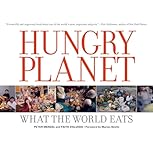
Peter Menzel, 2005 First, hardcover. Material World Books,
287-pages July 2006
Thirty families in twenty-four countries spread a weeks worth of food on
a table and pose for a picture, followed by a few pages about the family
and their shopping and eating habits, sort of like a National Geographic
article with one article (chapter) per family. It includes very specific
shopping lists of every food item, family recipes and pictures of the
family in their daily lives, usually involved with cooking or shopping.
The authors of the book are Californian organic eaters so they are
sensitive to the health aspects, in particular noting fast food
purchases and per-country obesity rates.
Fascinating. I read this over the course of about 30-days, with each of
my supper time's, so I became engrossed in it. It was disturbing to see
so much processed and pre-packaged food in the world today, even in
Mongolia. It was fascinating to see healthy and vibrant people living on
a diet that I would not consider healthy. It was fascinating to consider
my diet was probably healthier than any in the book (almost entirely
fresh fruit, vegetables and organic meats), that such basics are so
difficult to achieve in the world. Although the USA has the highest
over-weight per-capita, many countries are not far behind. Book is full
of interesting perspectives of the current state of the world and food
on a personal and understandable level. My favorite family is from
Bhutan, they eat rice three meals a day almost no meat and few veggies
or fruit, this diet just proves how basic or food needs to be to
survive, even thrive.
cover image
Gabriel Garcia Marquez 1955/1970/1986 First hardback,
106-pages July 2006
Nobel laureate Gabriel Garcia Marquez's re-telling of a ship-wrecked
sailor's trials alone on a raft at sea for ten days without food or
water. It was originally published in as a series of newspaper articles
in 1955, turned into a book in 1970, and translated into English by
Randolf Hogan in 1986. It is written in the first person from the
perspective of the sailor and was actually signed by him, Marquez's name
was not associated with the story until 1970 when it was first published
as a book. It's an interesting survival tale with an interesting
back-story in Marquez's career - the story's publication inadvertently
revealed corruption in the Columbia Navy which embarrassed the dictator
government which forced Marquez to take a job in Europe which opened new
opportunities for him. The story is a natural "Robinsonade" and so
appeals to that genre, all the more so because it is real, and involves
a Nobel laureate.
Roald Dahl, 1964
Hardback 2001, 162-pages July 2006
I knew the story from the 1971 Gene Wilder film "Willy Wonka & the
Chocolate Factory" and assumed the book was 19th century - so was
surprised to see it is recent and also essentially just a childrens book
(readable in 2 hours) - I was a deprived kid (must have been watching
too much "TeeVee"). Lots of fun, funny, would be best read aloud with
the many verbal puns.
The Economics of Attention: Style and Substance in the Age of
Information
Richard A. Lanham, 2006 First hardback, 276-pages June
2006
Lanham has been a university professor for about 40-years,
Yale-educated, English lit and rhetoric. He came of age pre-computer
revolution, when writing meant manual type-writers and white-out and
transcription. This series of connected essays are his ideas about what
the digital revolution means for the future of books, universities and
what he calls "the economics of attention" - how the world operates when
information is plentiful and the scarce resource are "eyeballs"
(attention). We are flooded with high-quality art, news, books, movies,
data of every type - it is not an "information economy" because
information is as plentiful as air - the scarce resource is peoples
attention. In that environment, style (the wrapping paper, the
ornamentation, packaging, literary style, etc..) becomes more important
than substance - style is the substance (think for example all the crazy
cultural things that come out of Japan - all style, no substance). He
also discusses how we interact with things: we look "at" them, or we
look "through" them - ie. we enjoy them for what they are, or we analyze
them. We read a novel/movie on a literary level and dissect how it was
created or and historical context, or we "get lost in the book" and
enjoy it for what it is. These two forces are in a constant tug of war
with every object we own - cars for example, utilitarian or style (or
some combo usually). In the end Lanham concludes it is the liberal arts
that will save the day for they are the ones who are trained to filter
(critics) and create design and style (the new substance). He also
provides the most detailed and lucid explanation I've seen on why paper
books have not been replaced by the digital medium.
Herman Wouk 1951 First
hardback 1951, 498-pages June 2006
This is really an amazing book. It is much better than the movie (which
everyone has seen and is excellent) however two things from the movie
spoiled it for me: Bogarts depiction of Queeg, and the dramatic trial
scene when Queeg cracks - in both cases the movie is better - but minor
gripes. The book is wonderful on many levels. The whole love affair is
a novel within a novel. Lots of literary themes going on. Symbolically
the "greatest generation" (characterized by its need for rules and
structure) is growing up, taking over from the "lost generation"
(depicted in the the first captain, characterized by tough pragmatism
and doing whatever it takes to get the job done). This is a cautionary
tale for an entire new generation who came of age in WWII - both the
good side (heroism) and the bad side (fascism) - Caine and Able. Wouk
really taped into the zeitgeist of 1950s America post-WWII. It is also
historically fascinating as one of the most accurate depictions of life
on board a US Navy vessel in WWII. Deserves to be in the canon of 20th
lit - but since it was so popular (NYT best-seller list for almost 3
years) it may take a while to be "respectable".
Among Stone Giants: The Life of Katherine Routledge and
Her Remarkable Expedition to Easter Island
Jo Anne Van
Tilburg 2003 First hardback, 247-pages June 2006
I first heard about this in the bibliography of Guns, Germs and
Steel, Jared Diamond raved about it. It is the life story of a
wealthy Victorian-era English Quaker woman who pioneered research of
Easter Island - in those days wealthy people did research trips as much
as for entertainment, financing their own ways. Her life turns out to be
very interesting and Tilburg does an excellent job, she was almost
completely unknown before this book. I learned a lot about Easter Island
ethnography, as well as the ethnography of 19th century English Quaker
families, and the changes they went through in the late 19th and early
20th centuries. Tilburg's greatest gift is to show historical
connections and continuity in a romantic manner. Memorable, incredibly
well researched (60+ pages of end-notes), personal and honest.
Washington
Irving c. 1820 Hardback, Borders Classics 2004,
176-pages June 2006
Collection of short stories by Irving. Includes:
Rip Van Winkle: Very short story. Based on German stories, so not
really original, but it is set in America and was one of the first popular
stories by an American author. Some interesting insights on pre and post
Revolutionary War viewpoints. The Legend of Sleepy Hollow: By far the best story he wrote. Very
enjoyable, good paceing, good mixture of humour and suspense. The movies
(Disney 1949 and Tim Burton 2005) don't do it justice. Disney is
better than the Burton, which translated it into a cheesy teen-horror
flick with the
latest CGI and an evil step-mother (although Burtons magical style is
worth seeing alone, looks like "Adams Family"). The Mutability of Literature: Interesting story about an old
library in which old books speak lamenting how they are never read.
Touches on issues very relevant today about "information overload" and
ideas versus objects. Fascinating given its age how relevant it is
today. The Spectre Bridegroom: Great story with a really good twist.
Didn't see it coming, really makes your flesh crawl. I won't forget this
story. Wolfert Webber: A pirate story. The description of the Inn and
the mysterious pirate with his chest are classic, certainly known by
Robert Louis Stevenson in Treasure Island it is very similar.
Jonathan Swift 1726/1735 Everyman hardback 1991, 318-pages + Oxford
World Classics paperback w/intro and endnotes, 2005 June 2006
I found this to be a difficult read. It is a satire of travel literature
(the preeminent form of literature in the early 18th century, like the
novel is today) which recounts impossibly fantastic stories in a
matter-of-fact manner that are uncomfortably obviously untrue (like many
of the travel stories it is satirizing). It takes a dark and negative
view of human nature that is disturbing, and is a fundamentally
pessimistic book told in a witty and humorous way. Probably among the
sickest of children-literature if it is read as such, but it has created
a mythology that is a part of western culture. As protest literature it
is way ahead of its time about colonialism and the idea of European
might makes right. As satire it is one of the best. Some of the concepts
can be found in later literature: the Yahoo's are like the wild-humans
on "Planet of the Apes". Many of the fantasy ideas are very rich indeed.
Overall - glad to be done with it! But if your going to read/write
satire, it should be as biting and uncomfortable as this.
Jean M. Auel 1980 harback, first 1980, 498-pages June 2006
Quest For Fire was always one of my favorite movies so Clan has
been a natural lifetime must-read. I'm a bit disappointed - the plot is
a sexual-revolution womens-lib fairy-tale which distracts from the
magic, one is always on-guard, is this allegory or science? The last
half of the book is just boring as she stretches a thin plot (see
below). But in the first half a certain magic does exist and although
science now says Humans and Neandrathals probably never mated, it's
still interesting to see "cave lifestyle" brought to life, in particual
the religious side - Jean did an excellent job of making the spirits
come alive and how much a part of daily life spirits probably were, not
just in the absrtract (not too disimilair to someone who believes
strongly in astrology). Glad to have read it, no desire to read the next
5 or 6 in the series.
Spoiler. From an amateur literary criticism POV, the plot had a lot of
connections to The Jungle Book and Robinson Crusoe, both 18th and 19th
century colonialization mythologies. Indeed the central plot is a direct
rip of Muglies Tales from Jungle Book, right down to the council held to
decide the "man-cubs" fate, and the evil snake who waits for the pack
leader to die before trying to kill the man-cub. The "robisonade" tale
of her surviving on her own and eventually conquering the natives, even
pro-creating a new species, has been re-imagined as the story of Homo
Sapians conquering Neandrathals. Thus for all its scientific trappings,
this is fundamentally Romanticism - for all its nods to womens lib, it
is pre-modern colonialization mythology.
I'm not sure why I "read" it, but it's pretty damn good, certainly
deserving of the Pulitzer. My inner-voice now sounds like a Irishman and
I'm cooking fried bread for "dinner" (lunch) and I have a better
appreciation for Catholic Irish (in particular poor Catholic Irish).
Also a better appreciation for modernity and what poverty is like: lice,
fleas, rats, TB, "consumption", yellow fever, sleeping in your clothes,
eating nothing but bread and butter as a staple, etc.. Frank's father
you wanted to yell at the whole time. Frank's mother was an angel. I
assume this is all true, it's hard to imagine making it up. This is the
real Ireland and the real Irish and explains a lot, another Native Son.
The authors voice and narrative are amazing, better than
reading.
Downhill All The Way: Walking with Donkeys on the
Stevenon Trail
Hillary Macaskill and Molly Wood,
2006 First, hardback, 154-pages June 2006
This is a cute book by two middle-aged English ladies (and various
friends) who hike the Stevenson trail in France (see Travels by
RLS below) with a donkey. I wanted to read it to get a first-hand
account of what the trail is like today. It's really very funny, in that
understated British humour sort of way. It's not particularly deep or
insightful - there is no journey into the abyss with only yourself
starring back - no great personal insights on life (although a few on
donkeys) - it's a light-hearted, light-stepped fun and easy read,
another piece of the myth created by Stevenson. Thanks ladies I enjoyed
the trip.
Jules Verne 1870 Restored and Annotated by Walter James Miller and
Frederick Paul Walter, 1993, 388-pages June 2006
This is a great book. No, this is an incredibly awesome book! This
edition was published in 1993, and is a completely new translation that
restores %25 of the original (from the French) and fixes 100s of errors
from the original English translation (which has become canon) , plus
extensive and fascinating footnotes. This book deserves to be in the
same league as Dracula and Frankenstein, it transcends the genre
boundries of scifi or boys-lit. It's influence has been extensive. I
found myself drawing it out, savoring each chapter and putting it
down even though I wanted to read more, making it last 5 days instead of
3. This edition by Miller and Walter is really half of why it's so good,
not only is the translation superb, the footnotes are a new realm to
themselves.
Update: Watched the Disney 1952 film. Takes a much darker
approach, Nemo is a crazed killer! Sad, so much more complexity. Also
the sub is a nuke, not electric. 4/5'ths of the adventures are cut.
Special effects are unforgettable.
Field Notes from a Catastrophe: Man, Nature, and Climate
Change
Elizabeth Kolbert 2006 First hardback 194-pages, +Audiobook 5hrs May 2006
Kolbert is a science reporter for the New York Times. She wrote a series
of human interest + science articles about the work various scientists
around the world are doing to study global warming. This is the book
version. It is, for me, nothing new except some arcane specifics about
work particular scientists are working on. The message is clear: we're
in trouble. For some reason it didn't translate well to audiobook, it
lost much of its power in spoken word. If you've never read a book on
global warming, or are curious about what scientists are doing and how
they know what they know, this is a great start. The real meat of the
matter is in the last 4 or 5 chapters or so.
Brutal Journey: The Epic Story of the First Crossing of North
America
Paul Schneider 2006 Hardback, first,
318-pages May 2006
Amazing story of 400 Spanish explorers who walked into the bush of
southern Florida in the 1520s and disappeared - eight years later four
survivors showed up on the west coast of central Mexico, dressed as
natives and carrying nothing but a few hundred indians worshiping them
as powerful shamans. In the intervening 8 years it was one incredible
adventure after the next, mostly dire tales of starvation, violence and
exotic peoples. They were the first to enter North America and cross it.
An otherwise little known story today, it was a classic best-seller in
the 16th century, retold here with the latest scholarly findings. There
are few comparable stories in the history of exploration, North America
was an entirely unknown continent.It reminds me of Africa with one new
and bizzarre and deadly tribe after the next.
As with Arctic Grail (the story of 19th century British
explorations to the Arctic), it is those who adapt to the native culture
and ways that survive, and those who remain loyal to thier supposed
Western cultural and material advantages that die. The lessons of "Guns,
Germs and Steel" are all over this story. In the end the survivors found
the keys to their success in dealing with the natives.
Update July 2006: Watched the 1993 movie Cabeza de Vaca
which loosely picks up the story from the time they land on the beach
till they are found by Spanish soldiers. Focuses heavily on mysticism
and magic (druggy-like scenes and music). Scenery and costumes are
"Quest for Fire" awesome. Parts are just like I imagined from the book.
But for whatever reason it's not a "great" film, but worth seeing if
you've read the book.
Pierre Boulle
1963 Hardcover, 1963 bookclub edition, trans by Xian Fielding,
191-pages May 2006
The movie (first one) has always been one of my favorites. The novel is
a lot like the movie (imagine that). I would say the ending of the movie
was better (they are both twist endings) - more twisted - the novel adds
a bit of un-needed complication with the frame tale. Anyway, I'll never
forget seeing the movie for the first time a youngster and when the
ending suddenly dawned on me. Even reading the novel the twist ending
gave me a shout of delight all over again. I'll have to read Logan's Run
next, another dystopia classic that shaped my world view for better or
worse in the 1970's.
Dan Rice: The Most Famous Man You've Never Heard Of
David Carlyon 2001 First hardback, 416-pages May 2006
Fascinating trip with of the most well-known and interesting Americans
of the 19th century. Anyone alive during the period 1850-1870 would have
heard of Dan Rice, he was the Johnny Carson of his time as notable as
Lincoln. Rice ran for President in 1878. This is a quality biography
well researched and reliable. Its listed at 500+ pages but the text
portion is 416, with a picture about every 3rd page. I think the fact
that he was an in-person spontaneous crowd entertainer of magnetic
charisma, before audio/visual and scripts; it's difficult to really
grasp what made him so great without seeing him in person. Reading his
dialog transcripts are flat, painfully so, you had to have been there in
person. I wish Carlyon had taken more artistic efforts to convey what a
circus was like, what Dan was like, more time is spent on controversy
and conflict with his professional peers than what actually made him so
appealing. There are occasional hints of what sound like fascinating
episodes in his life that never get developed. It often feels like
Carlyon spent months pouring over newspaper microfiche collections,
following Dan's life through the newspaper controversies (which may very
well be the only way) - but as Carlyon says, Rice knew that controversy
sells! One of the strengths of the book is its examination of the
changing zeitgeist of America in the 19th century - this is important to
understand why an entertainer is a star one decade, and yesterdays news
the next, even though nothing had changed - as Dan said one day to the
crowd: "What did I do wrong?", Carlyon, through the story of Rice, does
a good job of conveying the changing character and nature of America
between the 1840s and 1880s. This is also vital work for any student of
Mark Twain or fan of Huckleberry Finn.
Husain Haddawy (trans) 1992
Hardback Everyman's Library, 428-pages May 2006
This is the original "Arabian Nights", a collection of stories from Persia
from the 7th century to the 13th century. Haddawy's translation is
considered the modern definitive, going back to the original sources and
removing the stories that are not original added in the 17th and later
centuries (such as Ali Babba the thief and Sinbad the Sailor).
There is a lot of sex and violence but also incredible
stories of love, redemption and heroic quest. On par with the
Decameron, perhaps better. Very enjoyable, the world was a magical
place where the supranatural and extraordinary affairs merge with every
day life. Leaves a strong impression of place and time, it is easy to see
how this has influenced generations and the strong cultural myths it
created, truely one of the greats of World Literature.
Against the Grain: How Agriculture Hijacked Civilization
Richard Manning 2004 First hardback 211-pages April 2006
Richard Manning exposes the dark side of farming: ADM and the factory
monocrop culture seem to predominate, but interestingly the same problems
have existed since the dawn of agribusiness 10k years ago. I decided to
read this book after reading his essay "The oil we eat" (2004, The
Atlantic, see also "Coolreading I (2004)") which is outstanding. This is
an excellet book as well, the problem is he hits on so many different
ideas but he never fully expands on them - but the ideas are worthwhile.
For me, he is preaching to the choir and most of the stuff here is not
new, but I suspect for most people it's a point of view that would be
subversive. Manning doesn't offer new solutions other than the same old:
organic, slow food, buy local, diversify away from the mono-foods of
wheat/corn/rice/soy. I think the one thing that stuck with me was the
image of the collaboration between farmer, industry and government to sell
whatever food is in surplus - in America that is maninly corn so we find
corn products in everything - and that food is not seen as "food" but a
commodity, no different than coal or even money its self - a denatured
commodity disconneted from the relationship between grower and eater, and
the resultant abuses that occur to the food and environment.
John Steinbeck
1962 First hardback Bookclub edition 246-pages April 2006
Steinbeck named the book as a nod to RLS's Travels with a Donkey
(see below) which was one of his favorite books, and mine as well; plus I
love to drive solo across country getting lost and write about it, and
that's exactly what Steinbeck did with his dog Charley circumnavigating
the USA from Main to Seattle to Texas to New York, so it was a double
pleasure - I read it in one day. Steinbeck emphasized that a factual
travel account is never possible - even if the same events happen to the
different people they will remember or write or see it in different ways,
so travel literature is a very personal unique experience, not an
encyclopedic account. A great road trip book, very funny in parts.
Into Africa: The Epic Adventures of Stanley and
Livingstone
Martin Dugard 2003 Audio unabridged 11 hrs + First hardback 315-pages April 2006
This is my first "19th C African Explorer" book and what better way to
start it off than with the story behind the phrase "Dr Livingstone, I
presume?" - it is the story of how Stanley and Livingstone came to meet in
the African Congo; of the competitive history behind British and American
explorations of Africa; the competitive newspapers in America and England
that drove the stories into popular imagination; the competitive nature of
nations and the start of the rush for Africa in the later 19th century.
Stanley was an adventurer/reporter who pioneered the journalist+expolorer
"reports from the field". Martin Dugard has a similar background. Overall
this is an energetic, fascinating account of a whole host of characters
from diverse backgrounds who came together on the fateful day in the
middle of the Congo when Stanly walked up to the only white man in
thousands of miles whom he had been searching for months and said "Dr
Livingston, I presume?", entering into popular mythology forever.
Robert Louis Stevenson Project Gutenberg + Sony Librie, 558 KB
ascii April
2006
A collection of short stories written by Stevenson before he became
famous, published in various magazines in the late 1870s, including his
first published fiction. Composed of two "books", the first book is a
series of nested inter-related stories of diverse topics - thus the
allusion to the "Arabian Knights" whose stories were also nested.
Overall I found them to be "ok", mostly stories of upstanding Victorian
gentleman who find themselves involved in unseemly scenarios such as
murder, theft - all within the backdrop of the "anonymous city" (see
Balzac). Forerunner to Jekyll and Hyde.
James L. Swanson 2006 Audio abridged, narrated by Richard Thomas, 9hrs April 2006
The account of John Wilkes Booth assassination of Lincoln and the
subsequent 12-day manhunt through Southern Maryland and Northern Virginia.
This is one of those "reads like a novel" books, in part because the
author did so much fantastic research (it is his lifetime "magnificant
obession"), did such a great job writing it, but also because the actual
events are just so incredible. The book is being made into a movie
starring Harrison Ford for release in 2007 (filming started March 2006).
Martin Booth
2005 First, hardback, 337-pages April 2006
I'd never heard of English author Martin Booth before. He wrote this
personal memoir, recounting 3 years of his childhood age 7 to 10 in Hong
Kong in the early 1950s, written just before he recently died of brain
cancer. He dedicated the book to his own children, as a way to pass on the
story of his life to them. It reads like a novel - one incredible
adventure after the next of a boy of 7 let loose on the streets of Hong
Kong in the wild years after WWII. It also details the breakdown of the
marriage of his mother and father. This is a real treasure trove, a look
at the world through the new eyes of a child, but guided by the wise
perspective of an older author. I feel like I have traveled and lived in
Hong Kong - the sites, sounds, smells - the culture, food, weather,
animals, people - all brilliantly alive and real. I also have a better
sense of the Chinese and what it means to be Chinese, and a desire to
learn more. I only wish Martin had written a memoir of his entire life!
David Daiches 1973
Hardback exlib, 112-pages April 2006
Excellent short biography by well-known Stevenson scholar David Daiches
(1912-2005) - I think much of the text is from his 1947 "Robert Louis
Stevenson". Not only is it well written, respectful and sympathetic (no
muddying the waters with banal controversies), it has about 100 pictures
(which bring it to life), and some really good insights - like watching a
documentary.
Rudyard Kipling
1894-1895 Audio narration by Madhav Sharma (4hrs) + Gutenberg text April 2006
This is one of the best narrators I've heard and is perfect for the
subject, it's like an old wise Indian guru telling the stories for the
first time, truly a gifted story teller. The set here includes most of the
Mowgli stories from Kipling's "The Jungle Book" (1894) and "The Second
Jungle Book" (1895). The stories included are: "Mowgli's Brother", "Kaa's
Hunting", "Tiger! Tiger!", "Letting in the Jungle", "A King's Ankus" and
"Red Dog" - plus the poem "The Law Of The Jungle" (which shows up in the
middle of the "Mowgli's Brother" story). Most are abridged, some more than
others, however the abridgments are fairly well done - I read along with
the unabridged text (gutenberg.org) and could fill in the missing sections
- in some cases I think the abridgments actually improved the story. I'm
not usually one for abridgment but this is an exception, you can always
read the full text, the narration here leaves the imprint that makes it
come alive.
It really felt like reading a proto-Tolkien with wars between the animals
(races), special languages, histories and myths. Certainly Tolkien read
Kipling as a child and was influenced by it, as have been many others.
The scene with the elephants being recruited to destroy the village is
right out Tolkiens Ents destroying Saruman and the King's Ankus
is certainly The Ring that both rules and destroys men.
Update. December 2006. Completed reading the rest of The
Jungle Books, Border's hardcover edition. These are non-Mowgli
stories, but most have "talking animals" as central characters - not
limited to India. Some better than others but some very memorable and
leave a lasting impression. Wish I had read when younger!
This is an easy and fun history book (young adult) that blends excerpts
from Robert Louis Stevenson's "Amateur Emigrant" and "Across the Plains"
(see below) with Jim Murphy's prose and descriptions. I was expecting a
kids book but far from it - while not academic or even pretentiously so,
it's on par with a PBS episode of "American Experience" and reminds me of
how fun history can be. The historical photo's are excellent, numerous
and tightly connected to the text. Highly recommended for anyone
interested in RLS, American history and the immigrant experience of the
late 19th century. Jim Murphy has written about a dozen books like this
including some Newbury award winners, hope to read some more, the language
and prose is easy and leaves a strong impression of time and place, very
enjoyable.
James Matthew Barrie 1911
Project Gutenberg 1.0 + Sony Librie, 152 KB ascii
March 2006
Everyone knows Peter Pan, but who still reads the 1911 novel? Very
enjoyable, funny and sweet. Barrie was a school chum of Robert Louis
Stevenson and the depictions of Captain Hook and his ship the Jolly Roger
are clear nods to Treasure Island (even the Sea Cook is mentioned in
passing). Good story, often funny, works on multiple levels for children
and adults. Who wants to grow up?
The Adventures of Ibn Battuta: A Muslim Traveler of the 14th
Century
Ross E. Dunn 1986 First, hardback
319-pages March 2006
Ibn Battuta was a 14th century Moroccan Islamic scholar who spent about 30
years traveling throughout the Islamic world and beyond. It is one of the
great travel accounts of history easily comparable with Marco Polo. This
book is a scholarly gloss of his account designed for the non-specialist -
there are many complications to his itinerary and a lot of historical
background which are illuminated and explained. Each chapter covers a
particular region he traveled, with the first part of the chapter
providing the historical background of the region, with the second half
recounting Battuta's travels and experiences therein. Thus, not only does
one get an overview of Battuta's travels, but a fairly good 14th century
"world history". It is probably the most intimate and personal medieval
story I have read giving interesting details about daily living that bring
the era and people to life, while also providing a macro historical view
of the time. The only thing better would be to read the actual book - but
I think this contextual account and the primary source are both just as
vital to understanding.
Defining the World: The Extraordinary Story of Dr.
Johnson's Dictionary
Henry Hitchings 2005 Hardback
first 259-pages March 2006
Defining the World does for Dr. Johnson's 18th century dictionary
what Simon Winchester did in The Meaning of Everything for the
Oxford English Dictionary. A popular, readable and enjoyable
history. Hitchen's doesn't have the "spark" of Winchester's prose, he's
only 30 and it's his first book, but he is well versed in his subject-he
has a recent PhD on it in fact-the book is very well written. Most
memorable for me were the descriptions of life in London in the middle to
late 18th century and its many floppy characters. As befitting a book
about a dictionary, there is substantial discussion of words and
definitions and the many permutations-a seemingly dry subject but in the
hands of Hitchings under the guidance of Johnson's raw material is really
very funny and interesting. Unlike the OED, the Dictionary doesn't have a
dramatic creation story, other than Johnson's colorful character which is
as much mythology as reality. If for no other reason than I keep running
into "Doctor Johnson" and his dictionary everywhere I turn, this book
provided enjoyable context on what it's all about. As my studies will in
the future focus on the 18th century, Dr Johnson has become an
indespensible piece of culture to know about.
Patrick Leigh Fermor 1977 Hardback
1999 "Folio Society" 292-pages March 2006
Written in 1977 about his experience walking from Holland to
Constantinople in 1933. Considered a classic of travel literature. Fermor
combines the wild "recklessness" of his youth with the encyclopedic
knowledge of old age into this artistic work. Come prepared with an
Encyclopedia Brittanica 1911 edition and the Oxford English Dictionary,
this is an advanced-level course in European culture told through a rough
and tumble travel adventure of Europe between the wars. Mingle with
Counts, Barons and Dukes in Tutonic castles; gypies and harlots; drifters
and smugglers; farmers and peasants. Fermor is the height of European
19th culture on the brink of its destruction and reminds us what we have
lost. He also reminds of us the gentle giving nature of the people that
gave him food, lodging and help along his journey as a young man, it was a
time of gifts. I'll have to return to this when I am much older and can
appreciate the lifetime of knowledge contained within.
The copy is a 1999 "Folio Society" reprint, the quality of which is
outstanding with gilted cover, thick acid-free paper, new original
drawings, slip-case, and appears to be a facsimile. While I prefer
first-editions (or same time-frame), FS does an outstanding job.
This is a decent history of the Global Warming theory, from the 1880s to
about 2001. The theory entered mainstream knowledge in the 1970s, and
mainstream concern in the 1980s. By the IPPC report of 2001 it is now
beyond any reasonable doubt and is really no longer a science issue but a
social question, what do we do. There will always be science debate and
refinement, in particular how it will impact on a regional basis.
One of the scarriest things this book hit home was not the fact the world
is getting warmer, but how unstable the climate is -- there could be a
sudden and dramatic shift in a very short time (decades or less) -- we
don't know what that shift would be or how it would impact, but the risk
is there.
Mark Bittner 2004 First hardback 277-pages March 2006
A remarkable story which I read with my lapdog "Mitzy" on my lap bringing
closer understanding to the intelligence, communications and consciousness
of animals. It is also the story the authors voyage of self-discovery. A
real gem of a book, uplifting and positive. After the prior three lengthy
and depressing books this was the chaser I needed.
Anthony Shadid 2005 First
hardback 398-pages March 2006
Shadid is a reporter for the Washington Post and is half Arab, half
American (he easily passes for a native Arab). He was stationed in Iraq
from before the war to the elections in 2005. He won the Pulitzer Prize in
2004 for his reporting. Because he is Arab and speaks the language he is
able to easily interview people in all stations and positions of life in
Iraq and provide a unique introspection of the Iraqi people. Shadid is
there in person as the major events happen, interviewing people, watching
as the zeitgeist mood of the country changes over time with each major
event in the war, occupation and resistance.
What we learn from the book is that America is clueless about Iraq. We
also learn the Iraqis are mostly clueless themselves. There are countless
factions pushing and pulling in all directions, both internally and
externally, with each car bombing a game to guess who might have done it
and why. Iraqis are fiercely independent people, they operate according to
tribal law and blood feuds (the politics of revenge), who see America as a
provocative threat to their identity, and Saddam as the source of all
their problems. We learn that Iraq has been a living hell since the early
1980s when the Iran/Iraq war killed more than WWI/WWII combined (on a
per-capita basis) leaving a culture of death and crime in its wake. That
long-repressed religious forces have fused with nationalistic pride to
form militaristic religious armies. Of external Islamic movements twisting
Iraq to their purposes. Of tribal conflict, sectarian conflicts, inter and
intra-family conflicts.
I found this an emotionally difficult but required book. It is as close to
a history of Iraq post-invasion as there can be right now, it is all
first-hand accounts from Iraqis themselves, written by a reporter
sympathetic and understanding of Iraqi culture. Once you get into the mind
of Iraqi culture you realize how little the outside world understand this
highly complex and volitile "country". At the very end of the last page of
the Bibliography, stuffed with Middle East books, is one book that stands
out but speaks volumes: Native Son (see previous review below in
2005). If you understand Native Son, you are a long way to understanding
Iraq, "there's a little Bigger in us all."
Jared Diamond 2004 2005 hardback 525-pages February 2006
It's really multiple books in one; a history of 5 or 6 ancient
civilizations; a history of 3 or 4 modern civilizations; a "state of the
world" (circa 2003) on what the (12) major issues are facing the world in
the next 50 years; an overview of the mining, timber and marine fishery
industries (history, problems, solutions, future); a fascinating narrative
of life in modern Montana; a highly focused and up to date annotated
bibliography (best bibliography I've seen). All tied together with the
common theme that people today are little different than people of
yesterday and the lessons of the past are applicable to our future,
specifically focused on environmental issues and the fate of human
societies. That's it, not a complicated book, no grand theories like in
GGS, it's a better book - the lessons are timeless and nothing new, just
presented in the language and framework of the problems of our time.
Diamond is a wise sage with unique life experiences whose insights are a
treasure.
Thin Ice: Unlocking the Secrets of Climate in the World's
Highest Mountains
Mark Bowen 2005 First,
hardback 395-pages February 2006
This is the first book on global warming I have read, its hard to imagine
and more thrilling way to learn. It's also hard to classify, being about 5
books in one - the story of the career of scientist Lonnie Thompson, the
history of the discovery of global warming, a mountaineering book,
anthropoligical study of the rise and fall of civilizations due to
climate, and a history of the political debates.
Lonnie Thompson is my hero, a soft-spoken calm scientist from the hills of
West VA working in obscurity for 20+ years beneath the radar (from his
peers doing the big core drills at the poles), on exotic mountain glaciers
at 20k feet for weeks on end setting altitude endurance records.
Innovating new equipment and techniques. Building life-long teams of
dedicated mountaineering-scientests who are driven to find the evidence
the world is in trouble. Epic stuff. The combination of the science,
mountaineering, adventures, high-stakes political atmosphere, all combine
into a heady story that is impossible to put down.
Laurence Bergreen
2003 Hardback first edition 414-pages February 2006
History that reads like a novel. Fascinating account of Magellan's 1520s
first circumnavigation of the world. Widely considered the greatest voyage
of the Age of Discovery. Left with 5 ships and 260 men, arrived 3 years
later with 1 ship and 18 men. Beset from the start by corrupt officials,
rotting supplies, feuding crew, mutinous captains, scurvy, starvation,
blank charts, unreliable instruments, storms, tiny boats, deadly natives,
disease -- fear of sailing off the edge of the earth -- a captain
hell-bent on personal glory at the exspense of the mission -- all the
while changing how humans see the world -- there are few comparable
stories of human exploration.
Robert Louis Stevenson
1895 Project Gutenberg 1.0 + Sony Librie, about 200 KB
ascii February 2006
First leg of Stevensons journey from Scottland to meet and marry Fanny in
CA, it recounts his time on board a ship in the steerage compartment
(lower-class). Stevenson described the crowded weeks in steerage with the
poor and sick, as well as stowaways, and his initial reactions to New York
City where he spent a few days. Filled with sharp-eyed observations, it
brilliantly conveys Stevenson's perceptions of America and Americans. It
also provides a very detailed and enjoyable account of what it was like to
travel to America as an emigrant in the 19th century, during a time of
mass migrations to the New World. Details such as the bedding
arrangements, daily food rations, relationships with the crew, with other
grade ticket holders, passengers of other nationalities, entertainment,
children - all provide a rich and colorful tapestry of life on-board the
ship.
Robert Louis Stevenson
1883 Project Gutenberg 1.0 + Sony Librie, 187 KB ascii February
2006
Stevenson's unconventional honeymoon with his new wife Fanny in a "love
shack" in an abandoned mine in the mountains of Napa Valley CA. Provides
some interesting views of California during the late 19th century.
Stevenson uses the first telephone of his life. He meets a number of wine
growers in Napa Valley, an enterprise he deemed "experimental", with
growers sometimes even mis-labeling the bottles as originating from Spain
in order to sell their product to skeptical Americans. He visits the
oldest wine grower in the valley Jacob Schram, who had been
"experimenting" for 18 years at his Schramsberg Winery, and had recently
expanded the wine cellar in his backyard. Stevenson also visited a
petrified forest owned by an old Norwegian ex-sailor who had stumbled upon
it while clearing farmland.what the petrified forest was remained for
everyone a source of curiosity. Stevenson also details his encounters with
a local Jewish merchant, whom he compares to a character in a Charles
Dickens novel (probably Fagin from Oliver Twist), and portrays as
happy-go-lucky but always scheming to earn a dollar. Like Dickens in
American Notes (1842), Stevenson found the American habit of spitting on
the floor hard to get used too.
Robert Louis Stevenson
1878 Project Gutenberg 1.0 + Sony Librie, 215 KB ascii February
2006
Stevenson and a friend travel along the French canals and rivers in canoes
for "leisure". Outdoor travel for leisure was unusual for the time and
they were often mistaken for traveling salesman, but the novelty of their
canoes would occasion entire villages to come out and wave along the river
banks. Very well written, Stevenson was a true Romantic. Like many of his
works, this one is fairly unique, nothing else he wrote since is quite
like it in style or tone. It paints a delightful atmosphere of Europe in a
more innocent time with its quirky inn keepers, traveling entertainers and
puppeteers, old men who had never left their villages, ramshackle military
units parading around with drums and swords, gypsy families who lived on
canal barges.
Bruce Stutz 2006 First hardback 236-pages February 2006
Bruce Stutz is a 56 year old Jewish naturalist writer from Brooklyn who
after a heart-valve surgery decides to drive across the USA following the
progress of Spring, moving generally from south to north (map of route
included). I was drawn to this because I have driven across the USA on
solo trips with no particular itinerary just exploring and was interested
in traveling with a like-minded soul and seeing it from another
perspective. Some of the highlites of the trip include small town mardi
gras celebrations in Louisiana, the Punxsutawney Phil groundhog day, a
tour of the now-defunct Biosphere and its lone remaining tour-guide/guard,
hiking the deserts of AZ, the sandhills of Nebraska underneath which lies
the largest aquafier of water in North America, difficult climbing in the
mountains near Denver, birding on the salt flats, mushroom picking in the
OR Cascade Mountains with Asian pickers (a fascinating and new phenomenon
to me), flying into the ANWAR in Alaska with bush pilots.
Throughout Stutz emphasis es the nature of change not only of the season
into Spring, but of the changing weather and climate of the planet and how
this is effecting the natural world visably today. Never preachy, it is a
gentle and beautiful road-trip in a gas-guzzling 1983 Chevy, appropriately
nick-named "Moby Dick" for its large "whale" of a size, white color, and
for anyone who has read the novel, a metaphor for the elements of life
that are out of our control. A book well worth reading for anyone
interested in travel, nature, a changing world and the promise of Spring
around the corner on a winters evening.
Robert Louis Stevenson 1879 Project Gutenburg 1.0 +
Sony Librie, 208 KB ascii February 2006
One of the forerunners of the modern outdoor travel narratives. Stevenson
traveled 12-days and 120 miles through the south-central Cevennes mountain
range in France in 1879. The region is still do this day one of the
poorest in France, and in 1703, it was the scene of a bloody Protestent
rebellion against the Catholic church (also the same region that the
Cathars were active during the bloody Albigensian Crusade). This appealed
to Stevenson in part because the geography of similar to his native
Scotland, rocky treeless mountains covered in heather, and the history of
a minority Protestent uprising against an oppresive majority lay over the
land and people. Stevenson was sickly most of his life and craved
adventure. He also needed to make money and this was his second book,
before he became the well-known author with "Treasure Island". Provides
some interesting details of an early "sleeping bag", large and heavy
enough to require a donky to carry.
Update: March 2006. Created an annotated version see The
Annotated 'Travels with a Donkey in the Cévennes'. Very cool and
rewarding experience to research Stevenson's references, much more
sophisticated and enjoyable work on second reading than it appeared at
first.
Update:April 2006. Listened to a (lightly abridged) audio version
narrated by Billy Hartman, 2001, who has a wonderful Scots accent which
brings alive the rythem and sounds of Stevenson's writings, adding a whole
new dimension, plus some cool 19th century music between sections. I
picked up a few things I missed by reading, it's interesting how both
spoken work and text can convey different meanings even when they are the
exact same words.
Oscar Wilde
1891 Project Gutenburg v1.0 + Sony Libre, 312 KB ascii February
2006
First book read on a Sony Libre. The experience has both advantages and
disadvantages over a book. It seems easier/faster to read since page
turning can be done with a slight press of the thumb using the same hand
that holds the Libre, which has no weight or bulk and can be read anywhere
from any angle or lighting (4 AAA batteries last for 7,000 page turns).
It's also nice to have 17,000 Gutenburg texts on-hand at a moments notice.
Downside is no physical book, which has more character and charm and
tactile feedback - however after 20 years of reading material online
anyway, nothing new there, and there are always real books to read that
are not online. Hard to markup and take notes and flip back to passages
via the Libre, but easy to do so with the text file on a computer.
Having seen the classic 1945 B&W film I was expecting a similar plot but
it is significantly different. Throughout are some stunning insights on
human nature, the nature of relationships - potentially "dangerous"
insights. While the unique "ageing picture" device gets a lot of
attention, I think the real value of this work is the self-referencial way
Wilde shows the corruption of innocence through a young mans exposure to
literature (Joris-Karl Huysmans's "Against the Grain"), all the while the
novel itsself contains very dangerous corrupting ideas for the reader. Not
a novel to take too seriously (or not).
Harper Lee 1960 Hardback
1999 (40th anniversary) 323-pages January 2006
I could have read it in 2 days but the chapters are so delicious I had to
slow down and let them sink in and spread it out over about 8 days, like
sipping a drink you dont want to end. Voted best novel of the 20th century
by a poll of American librarians. Pulitzer Prize.
The Fall of the Roman Empire: A New History of Rome
and the Barbarians
Peter Heather 2005 First USA hardback 459-pages January 2006
Peter Heather (Oxford) is a leading expert on barbarians (he's written 3
books about Goths and Huns), and is under contract (for some of these
books) by a leading European-wide institution. The book is subtitled "Rome
and the Barbarians", and thus unsuprisingly, in his final analysis Rome
fell because it was overwhelmed by external barbarians, and not (entirely)
because of internal reasons, which is usually the more common explanation
(Christianity, civic pride, economic and cultural stagnation, etc..) - and
further, the barbarians invaded the Empire because they were in effect
blowback from 400 years of Imperial aggression ("By virtue of its
unbounded aggression, Roman imperialism was ultimately responsible for its
own destruction"). Rome in effect created the barbarian menace, who were
forced into more politically organized and dangerous super-groups. In a
post-911 world this sounds suspiciously like an aggressive "American
Empire" suffering blowback from modern day "Islamic fundamentalist", a
popular view in some circles. Although Heather draws some parallels with
the history of the British Empire, in any case it certainly has a topical
feel to it.
Whatever the possible modernisms (a minor gripe given the good points and
probably unavoidable in any history book), this is an excellent book that
I highly recommend for its riveting narrative, asking the key questions
(and providing answers, even if educated guesses), dispelling old notions,
illuminating a lot of new information about the barbarians and the Huns in
particular, and providing a structured story from start to finish that is
unforgettable. Heather reminds me of Runciman in his classic political
narrative style. I've read 4 other narratives of this period and they all
leave more questions than answers about a very complicated series of
events to the point it just seems like one random contingency after the
next, as un-interesting as the trajectory of a pin-ball game; but "Like a
late Roman emperor, Heather is determined to impose order on a fabric that
is always threatening to fragment and collapse into confusion; unlike most
late Roman emperors, he succeeds triumphantly."
Karen Armstrong
2005 First hardback 149-pages January 2006
Short book that provides a survey overview of the different stages of myth
from Palaeolithic (hunters) -> Neolithic (farmers) -> Early Civilizations
(4000-800 BC) -> Axial Age (800-200 BC) -> Post-Axial (200-1500 AD) ->
Great Western Transformation (1500-2000 AD). Within each period the myths
we live by are relevant to the way we interact with the world, such that
in Neolithic the gods were of the earth and life came from the earth while
in the Early Civilizations the gods were more like judges who imposed law
and order. She says that as of 1500 AD myth had died replaced by
scientific revolution, but myth is still important and lives-on today in
the form of the novel, litereature and movies, mythical stories that are
relevant to everyday life. Of course this final conclusion may be
influenced that this book is the first in a series by the publisher to
retell popular old myths, this serving as a sort of introduction. I've
never read about myths (beyond college) and hope to read in more detail
from other authors in the future.
HM Tomlinson
1912 Hardback 1928 Everyman edition 371-pages January 2006
A travel narrative classic about the first English "tramp steamer" to
traverse upstream the Amazon river nearly 2000 miles. Great insights on
life, the jungle, the early days of Amazon pioneer settlements. Some of
the personal insights are powerfully true, themes of civilized man versus
the wild man, mans exploitation of the environment and each other. Written
with a very cheeky humerous style parts are absolutely hillarious (fishing
with dynamite is a highlite). Parts are very atmospheric such as the story
of the old man in the gin bar (see excerpt
here). Wonderful sense of place and time, natural lore and human
emotion, well worth the journey.
Benson, Alephonsion & Benjamin w/ Judy
Bernstein 2005 First hardback 311-pages January 2006
This made me cry. Twice. Powerful. It is the true account, told in their
own words, of three orphaned brothers, "Lost Boys" from the Sudanese civil
war (over 2 million dead) who were eventually resettled in America. After
they became orphaned at around ages of 5 during at attack on their jungle
village, for 14 years they wondered around southern Sudan, miracously
escaping one close death after the next from thirst, starvation, wild
animals, exhaustion, disease, injury and of course constant civil war -
all the while searching, finding, loosing each other, finally to be
resettled in America. Through it all they retained respect and dignity.
This is a major wide-eye opener of how people are living, right now today.
Incredible and heart wrenching.
Charles Dickens 1861 Norton
Critical + Audiobook (Frederick Davidson), 358-pages + 19 hours January
2006
Until about 1940 or so this was one of Dicken's more obscure works, not
that popular in its time, but has since come under the critical spotlight
(thanks in large part to some papers written by George Orwell and others),
to the point today it ranks as one of his most well know, probably in
large part to the attention paid it in academic settings. I found the
first 1/3 of the novel to be excellent in the same way David
Copperfield where Dickens talent for showing the world from the
perspective of a child shines. As Pip gets older and enters into manhood
the story begins to drag, finally all the plot elements come together in
the final 1/6th of the novel, making the majority of the story often,
well, boring; the climatic scenes are just not that climatic (but never
predictable and often surprising). The ending was also not happy, as I
would have expected it (the original ending anyway), but appropriate and
refreshingly non-"Hollywood" (of course).
I particularly enjoyed the river journey which was vividly clear, the
light of the stars on the water being broken by the paddle of the oars.
The opening scene of Magwitch ("witch" being the operative word) in the
graveyard. The character Jaggers the lawyer, who reminds me of a lawyer I
know. There are some very poetic and lyric passages, I hope to re-read
again to think more about the poetic choice of words. I also enjoyed the
food descriptions throughout, gave a real sense of what people ate in
Victorian England (lots of milk, rum, eggs, bacon and biscuits).
Dicken's brother died just as he started writing the story and while it
certainly deserves credit (many very intelligent people say its his best
work, and he was the best author of the 19th century, making this the..)..
I found it overall just somewhat dark and depressing and boring, except in
parts which were outstanding. An oppresive darkness broken by flashes of
brilliance pretty much sums it up, at least on first reading.
Edgar Wallace, Merian Cooper,
novelized by Delos W. Lovelace 1932 Hardback 1976 185-pages January
2006
King Kong was initially concieved as a screenplay by Wallace and
Cooper. Lovelace novelized the screenplay and released it before the movie
came out. It's a fast read non-stop action (like a movie). There is
nothing particularly deep about the writing since it's just a written
version of the movie (indeed it reveals how shallow movies can be compared
to literature, but this comes after just finishing a Wharton novel by
comparison, McDonalds vs fine French cuisine). The language is 1930s wise
guy with lines like "look here" and "tough egg" and "shove off" peppered
throughout (and not in a nostalgic way, the "genuine article"). King
Kong is of course part of the "Lost World" genre started by King
Solomons Mines (see 2005 Cool Reading), but is most influened by Edgar
Burroughs The Land that Time Forgot (see 2005 Cool Reading) and
Arthur Conan Doyle's The Lost World.
Edith Wharton 1920 Hardback
1920 first(?) 365-pages January 2006
1920 novel by Edith Wharton which won the 1921 Pulitzer Prize. The novel
takes place among New York City's upper class during the 1870s, before the
advent of electric lights, telephones or motor vehicles; when there was a
small cluster of aristocratic "old revolutionary stock" families that
ruled New Yorks social life; when "being things" was better than "doing
things" - ones occupation or abilities were secondary to heredity and
family connections, when reputation and outward appearances came at the
exclusion of everything and everyone else. When gentleman were lawyers and
ladies were ladies and the "clever people" did everything else. When 5th
Avenue was deserted by nightfall and it was possible to follow the comings
and goings of society by watching who went to which household along it.
The plot is a love story, but is also well regarded for its accurate
portrayal of how the upper class of America at one time lived, for which
it won the Pulitzer (The Magnificent Ambersons (1918) by Booth Tarkington
won a Pulitzer for almost the same reason just a few years earlier, except
set in the Midwest). Wharton, born in 1862 and aged 58 at the time of
publication, herself lived in this rarefied social world, only to see it
change dramatically by the end of WWI, when she looked backed and
reminisced about a bygone "age of innocence".
Wharton was good friends with Teddy Roosevelt (see below).
Candice Millard 2005 Hardback first 353-pages January 2006
A timely tale of Americas great naturalist, Theodore Roosevelt, journey
into the Amazon rain forest, a modern metaphor for the alienation of the
American environmental movement in its darkest hour since Roosevelt
created the first national parks.
Well written, well researched, interesting, entertaining, page turner.
Millards use of direct quotes in re-telling the story is superb. The drama
and Freudian symbolism was in parts over-emphasised for the sake of the
story with little mention about the fun and enjoyment of the trip. Most of
the hardships were the result of poor planning, so its not so much a great
adventure in overcoming nature, as a lesson in what not to do, sheer luck
and overcoming internal blinders. Beyond the great book by Millard, I
leave with two gifts from this journey: The incredible person of Rondon
the Brazilian national hero who I plan to read more about, and the classic
book "The Sea and the Jungle" referenced throughout the book.
This work is licensed under a
Creative
Commons Attribution-No Derivative Works 3.0 United States License.
This license is for each book review, 1 license per book review. For No
Derivative purposes, the license covers only the book review portion of
each entry. Fair Use quotes are OK so long as attribution.